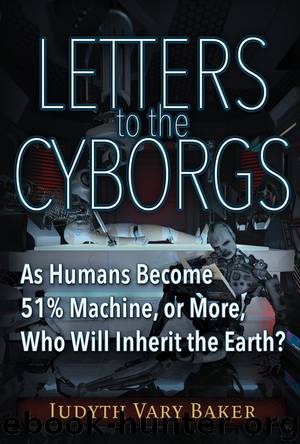
Letters to the Cyborgs by Judyth Baker
Author:Judyth Baker
Language: eng
Format: epub
Tags: Nonfiction
Publisher: Trine Day
Published: 2016-06-15T21:12:33+00:00
* * *
1 1. http://weburbanist.com/2007/11/02/suburban-abandonments-missile-silos-for-exploration-visitation-and-even-for-sale/ Retrieved July 23, 2015.
2 2. IBID.
3 3. http://www.botswana.co.za/Echoes_of_Eden-travel/life-of-termites.html Retrieved July 18, 2015.
4 4. http://www.metanexus.net/essay/h-cybernetics-antihumanism-advanced-technologies-and-rebellion-against-human-condition “H-: Cybernetics Is An Antihumanism: Advanced Technologies and the Rebellion Against the Human Condition” September 1, 2011 by Jean-Pierre Dupuy. Comments are excerpted from his essay, and the some of the arguments in “Termites” are based on quotes from DuPuy’s essay, available below. “Professor Jean-Pierre Dupuy is a Professor of Social and Political Philosophy at the École Polytechnique, Paris. He is the Director of research at the C.N.R.S. (Philosophy) and the Director of C.R.E.A. (Centre de Recherche en Épistémologie Appliquée), the philosophical research group of the École Polytechnique, which he founded in 1982. At Stanford University, he is a researcher at the Study of Language and Information (C.S.L.I.) Professor Dupuy is by courtesy a Professor of Political Science… “ “In his book The Mechanization of the Mind, Jean-Pierre Dupuy explains how the founders of cybernetics laid the foundations not only for cognitive science, but also artificial intelligence, and foreshadowed the development of chaos theory, complexity theory, and other scientific and philosophical breakthroughs.“ https://dlcl.stanford.edu/people/jean-pierre-dupuy
Selected quotes from his essay:
“[N]atural sciences have become exclusively sciences of process and, in their last stage, sciences of potentially irreversible, irremediable “processes of no return.”... In her masterful study of the perils facing mankind, The Human Condition (1958), of which we are celebrating the fiftieth anniversary, Hannah Arendt … [warns us that] the overweening ambition and pride of a certain scientific humanism leads directly to the obsolescence of mankind…”
“In June 2007, the occasion of the first Kavli Futures Symposium at the University of Greenland in Ilulissat, leading researchers from around the world gathered to announce the convergence of work in synthetic biology and nanotechnology and to take stock of the most recent advances in the manufacture of artificial cells. Their call for a global effort to promote “the construction or redesign of biological systems components that do not naturally exist” evoked memories of the statement that was issued in Asilomar, California more than thirty years earlier, in 1975, by the pioneers of biotechnology. Like their predecessors, the founders of synthetic biology insisted not only on the splendid things they were poised to achieve, but also on the dangers that might flow from them. Accordingly, they invited society to prepare itself for the consequences, while laying down rules of ethical conduct for themselves. We know what became of the charter drawn up at Asilomar. A few years later, this attempt by scientists to regulate their own research had fallen to pieces. The dynamics of technological advance and the greed of the marketplace refused to suffer any limitation.”
“The human subject will therefore need to have recourse to a supplementary endowment of will and conscience in order to determine, not what he can do, but what he ought to do – or, rather, what he ought not to do.… His will and capacity for choice are now left dangling over the abyss. The attempt to restore mind to the natural world
Download
This site does not store any files on its server. We only index and link to content provided by other sites. Please contact the content providers to delete copyright contents if any and email us, we'll remove relevant links or contents immediately.
| Fantasy | Gaming |
| Science Fiction | Writing |
Sita - Warrior of Mithila (Book 2 of the Ram Chandra Series) by Amish(54813)
The Crystal Crypt by Dick Philip K(36831)
Cat's cradle by Kurt Vonnegut(15293)
Always and Forever, Lara Jean by Jenny Han(14868)
Ready Player One by Cline Ernest(14612)
The Last by Hanna Jameson(10224)
Year One by Nora Roberts(9758)
Persepolis Rising by James S. A. Corey(9332)
The remains of the day by Kazuo Ishiguro(8943)
Never let me go by Kazuo Ishiguro(8844)
Red Rising by Pierce Brown(8727)
Dark Space: The Second Trilogy (Books 4-6) (Dark Space Trilogies Book 2) by Jasper T. Scott(8156)
The handmaid's tale by Margaret Atwood(7725)
The Circle by Dave Eggers(7089)
Frank Herbert's Dune Saga Collection: Books 1 - 6 by Frank Herbert(7036)
The Testaments by Margaret Atwood(6861)
Legacy by Ellery Kane(6633)
Pandemic (The Extinction Files Book 1) by A.G. Riddle(6507)
Six Wakes by Mur Lafferty(6218)
